
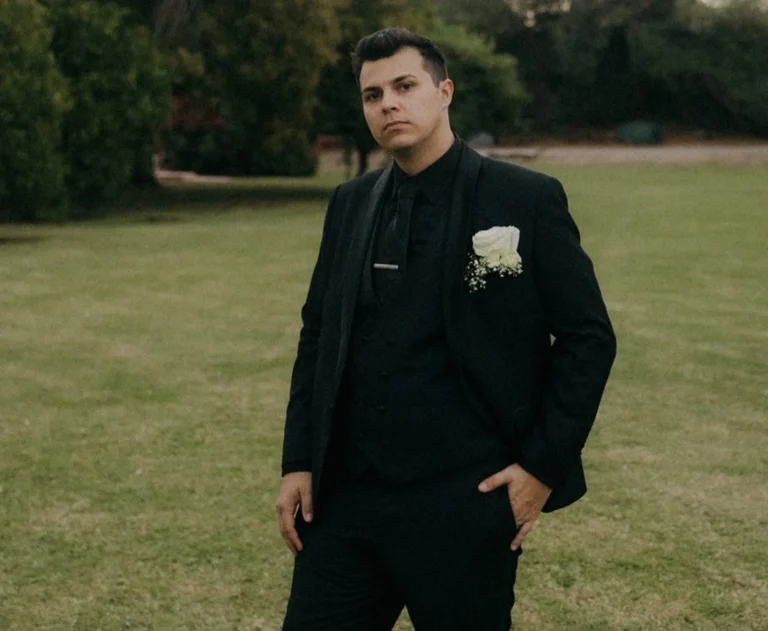
Photography by @tarahsheaphotography
Nothing ruins your wedding day faster than a poorly fitted suit that restricts your movement and looks awkward in photos. This issue directly impacts you and your groomsmen when you’re standing under the bright desert sun in the Valley. We will walk you through the exact fitting protocols and fabric choices you need to achieve a flawless, confident look.
At Van Allan’s Mens Fashion, we provide a comprehensive wedding suit fitting Phoenix grooms trust for precision and comfort. Style choices only work when the underlying fit is precise. A garment that looks acceptable in the mirror often fails when you’re actually moving. We also provide practical guidance on what to wear when getting measured for a suit to ensure the tailor captures the most accurate baseline.
Arizona weddings demand garments that withstand intense desert sun and high humidity without compromising structure. You might think all wool is too heavy, but our 100% wool suits feature a lighter, breathable fabric that actually moves with your body. We also carry a lightweight blend perfect for the spring and summer months that most of our customers pick out for their wedding parties.
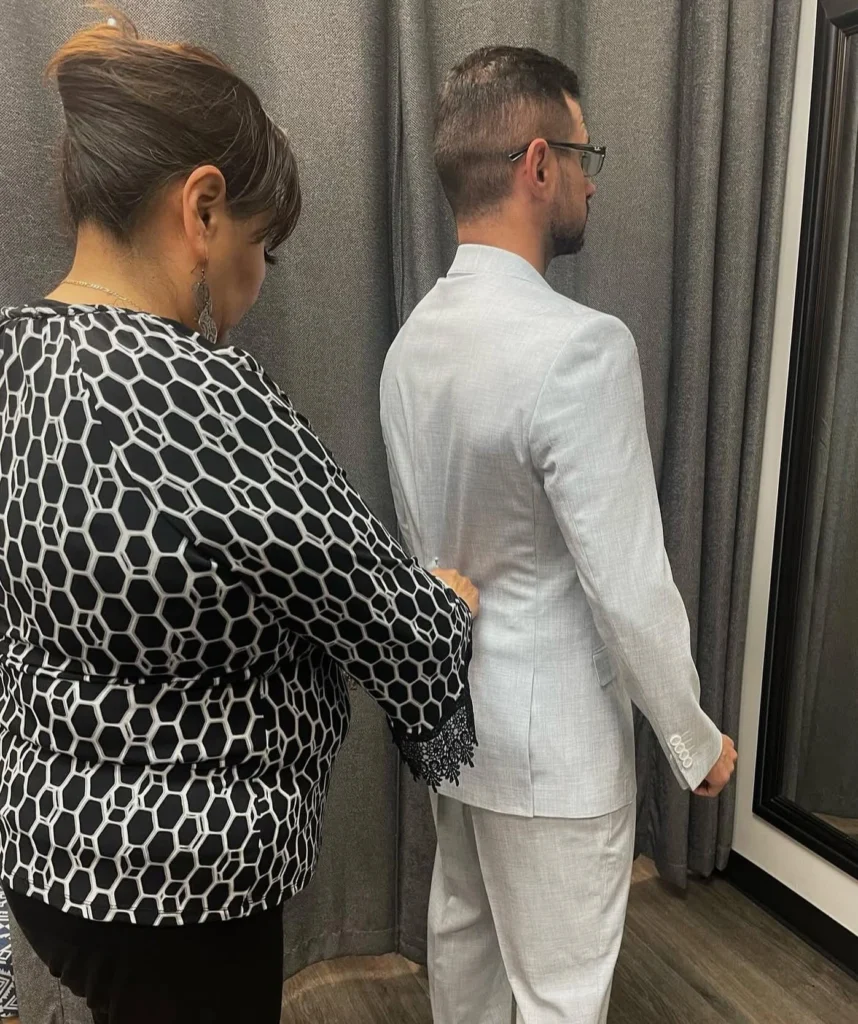
Evaluating the Torso and Jacket Length in Phoenix
Understanding how to measure for a suit requires applying the flat-hand test for the chest and the knuckle rule for the hem to achieve the perfect torso and jacket length. A properly fitted chest allows one flat hand to slide comfortably between the fabric and your body without creating X-shaped pulling lines. These precise suit measurements ensure the jacket provides enough room for comfortable movement while maintaining a sharp, tailored silhouette.
The knuckle rule dictates that the jacket hem must align perfectly with the first knuckle of your thumb when your arms rest naturally at your sides. This specific measurement guarantees the jacket fully covers your seat while balancing your overall body proportions. A hem that falls too short looks overly trendy in photographs, while excess length creates a sloppy appearance for the entire wedding party.
Grooms often prefer a slightly cleaner, more tailored chest to stand out during close-up photos and vows. Your groomsmen still need to feel completely comfortable and natural while matching your overall visual proportion. We provide precise adjustments that keep the entire party looking coordinated without sacrificing individual comfort.
Perfecting Your Sleeve Length and Pitch in the Valley
Perfecting your sleeve length means ensuring exactly 0.25 to 0.5 inches of your shirt cuff is visible when your arms hang naturally at your sides. This precise measurement creates a refined, intentional appearance that looks incredibly sharp in close-up photos of your rings and vows.
If your jacket sleeve twists or bunches up at the armhole, you’re likely dealing with an incorrect sleeve pitch angle. We fix this hang issue by resetting the sleeve to match your natural arm rotation, ensuring the fabric falls perfectly straight without any awkward bunching.
Getting this detail right for both you and your groomsmen guarantees a cohesive, polished look across the entire wedding party. You’ll want every single photo to capture the confidence and comfort of a flawless fit, rather than distracting sleeve adjustments.
Achieving the Perfect Trouser Fit for Your Desert Wedding
You achieve the perfect trouser fit during your wedding suit fitting Phoenix appointment by making sure the waistband sits comfortably at your natural waist and choosing the right hem break for the Arizona climate.
Knowing how to measure yourself for a suit ensures your trousers sit securely without needing a belt to hold them up all day. We’ll make sure there is enough room for a finger or two inside the waistband while keeping the back completely smooth. The rise also needs to sit cleanly through your seat and crotch so you can sit, bend and dance without any restriction.
We’ll always have you walk around the showroom to test the thigh fit in real time. Excess pulling across the leg means the cut is too tight, while extra fabric ruins your clean silhouette. You’ll need complete freedom of movement to feel totally at ease during your reception.
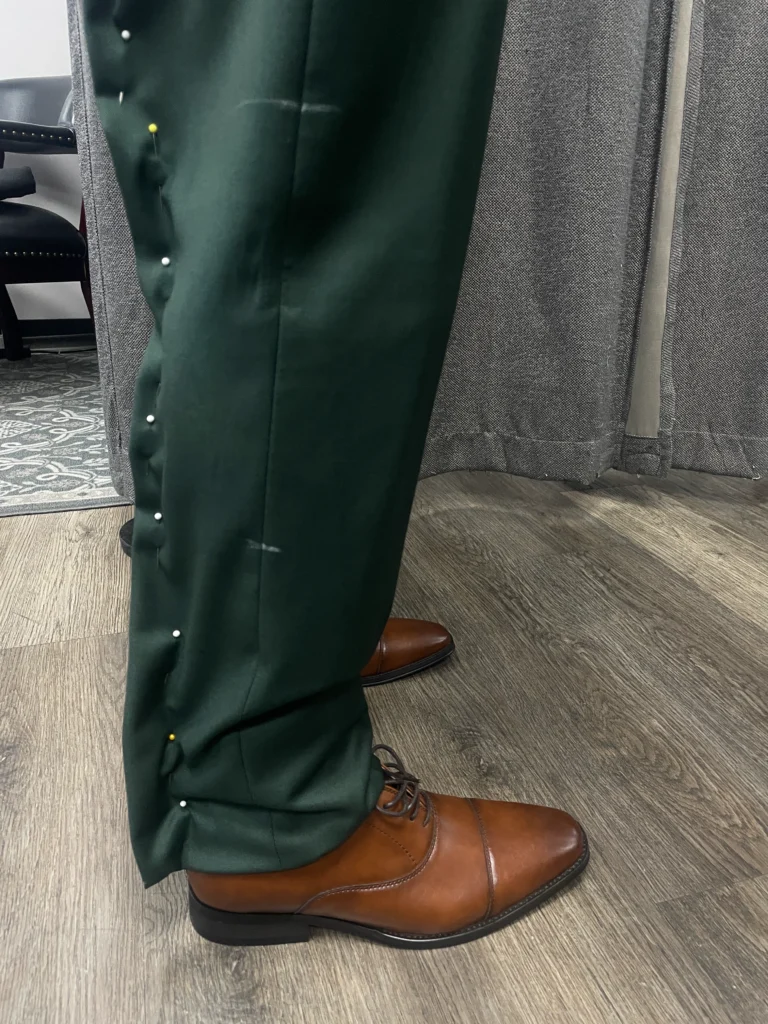
For a desert wedding, we typically recommend a no-break or half-break hem to keep your look crisp and lightweight. A no-break hem rests just above your shoe for a sharp, modern appearance, while a half-break creates a slight fold for a classic vibe. This specific detail ensures your trousers maintain a sharp appearance during the ceremony and the reception.
How do you coordinate the groom and groomsmen look in the Valley?
You coordinate the group by focusing on tailoring precision during the wedding suit fitting in Phoenix, ensuring you look like the sharpest version of the exact same outfit. There is a fine line between a coordinated wedding party and a cloned one, and the secret lies in the details. Your groomsmen need to feel completely comfortable and natural in their fits. Meanwhile, your specific tailoring can be just a bit sharper to give you that main-character confidence.
This means keeping the general suit style and fabric family identical across the board. A slightly cleaner jacket taper or a perfectly executed sleeve length gives you that subtle upgrade. You avoid looking like you are wearing a completely different outfit from your friends. You simply stand out through superior fit precision rather than a dramatically different cut.
Here is the reality of group photos: consistency is absolutely everything. You might be asking yourself, “How do we ensure consistent fit for out-of-state groomsmen?” We provide precise adjustments and coordination for every single member of the wedding party. This guarantees everyone matches in quality and tailoring standards, no matter where they are coming from.
Think about it this way. You are investing in a flawless look for your big day, and your closest friends deserve to feel just as confident. Getting the fit right for everyone creates a cohesive, unforgettable experience. You get to walk away with amazing photographs that capture the true vibe of your wedding party.
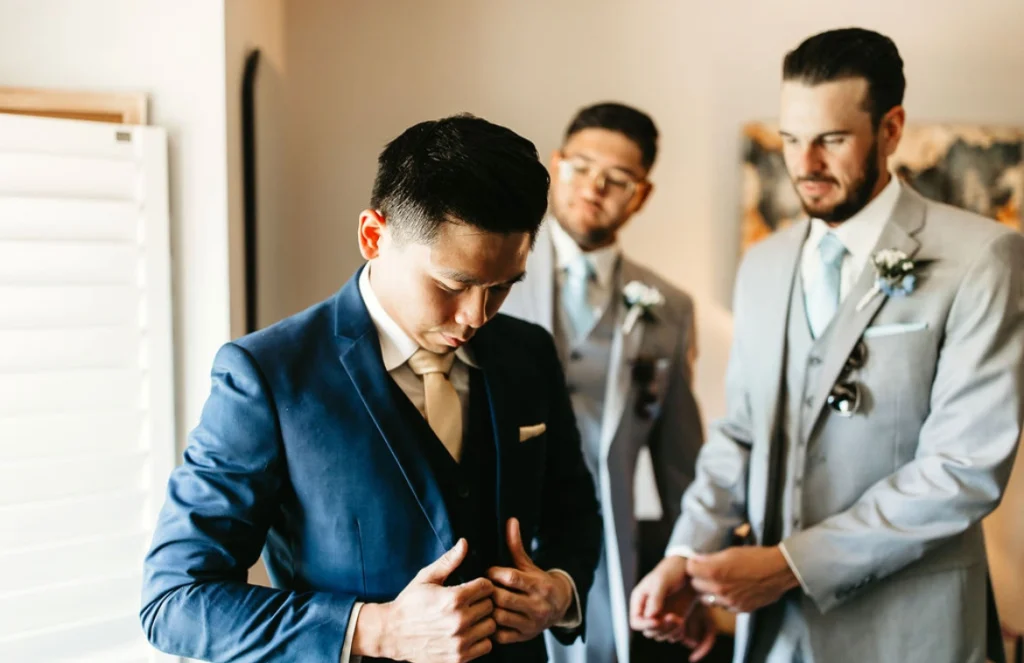
Photography by @kristinbendigophotography
Why your dress shirt fit dictates the entire jacket silhouette
Your dress shirt must touch your neck without choking and avoid ballooning in the torso to prevent ruining the tailored lines of your jacket. A loose shirt completely destroys the clean silhouette of a perfectly tailored jacket, while a tight shirt restricts your movement and looks strained in photos. The sleeves need to reach exactly down to your wrist bone so the jacket sleeve can properly show that crucial quarter-inch of cuff.
You might be wondering, how should a dress shirt fit under a suit? The truth is, it should feel like a second skin without restricting your movement. You’ll want to feel completely at ease when you’re hugging your family and dancing at the reception. Getting the shirt fit right during your wedding suit fitting in Phoenix guarantees that your suit actually performs the way it was designed to.
When should you schedule your wedding suit fitting in Phoenix?
You should schedule your initial wedding suit fitting in Phoenix at least three to four months before your big day, aligning with the standard wedding attire timelines recommended by top planners. Waiting until the last minute is the fastest way to add unnecessary stress to your planning. When you give us a solid window, we can perfect every single detail on your wedding suits without rushing the process.
Think about the logistics of getting your entire groomsmen squad on the same page. You might be asking yourself, “Can you measure my groomsmen remotely or ship suits to them?” We provide exact protocols detailing what measurements are needed for a suit alongside remote coordination options for the groomsmen flying in so everyone looks uniform. This proactive approach eliminates those day-of panic moments and keeps your group photos looking flawless.
You can lock in your timeline and secure your wedding suit fitting Phoenix by getting on the calendar early. Book your fitting today by calling (602) 512-9003 or emailing info@vanallansmensfashion.com. This proactive step guarantees you get the exact date that works best for your wedding party.